
MicroPython Coding Class in Penang
Learn Python, electronics, IoT, sensors, LEDs and Raspberry Pi Pico W through practical hands-on projects at Code Genius Penang.
What is MicroPython?
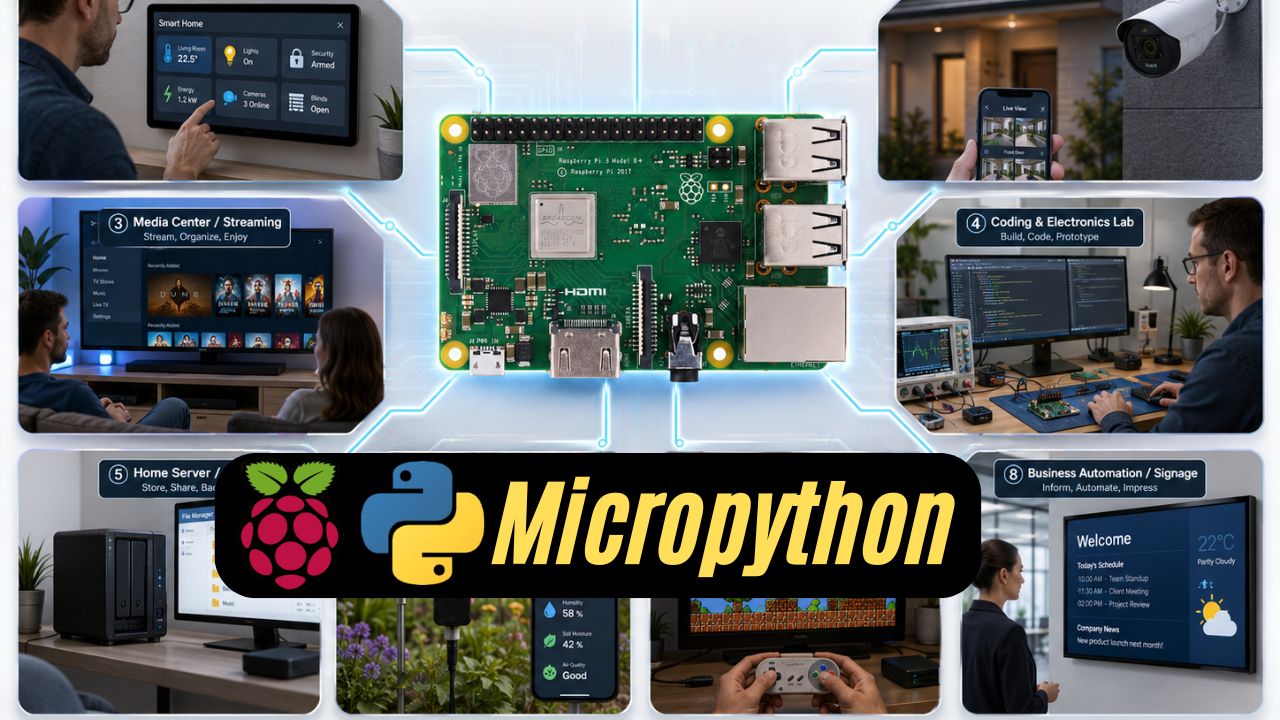
At Code Genius Penang, we provide a practical MicroPython course for students and adults who are interested in learning programming, electronics, IoT and robotics. MicroPython is a small and lightweight implementation of the Python programming language designed to run on microcontrollers such as the Raspberry Pi Pico / Pico W, ESP32, ESP8266 and other similar development boards. One of the main advantages of learning MicroPython is that your Python code can run directly on small electronic boards and interact with real hardware. This makes MicroPython an excellent starting point for anyone who wants to explore robotics programming, electronics, automation and Internet of Things (IoT) development. Many young developers begin their journey into IoT by learning how to use MicroPython to control LEDs, buttons, sensors, displays and other electronic components.MicroPython Libraries You Will Learn
During the course, students will be introduced to several useful MicroPython libraries and modules commonly used in Raspberry Pi Pico and ESP32 projects.Simplifies working with LEDs, buttons, buzzers and sensors.
Controls GPIO pins, PWM, ADC, I2C, SPI and other hardware functions.
Used for delays, timing and controlling program execution.
Provides Raspberry Pi Pico specific functions and PIO capabilities.
Reads temperature and humidity data from DHT sensors.
Communicates with compatible digital sensors using the 1-Wire protocol.
Controls individually addressable RGB LEDs.
Many more devices we will cover
MicroPython Course Structure
At Code Genius, students begin by learning the fundamentals of Python and electronic components before progressing into MicroPython projects using the Raspberry Pi Pico W or ESP32. Students will learn how electronic components work and how they are connected using devices such as breadboards, wires, resistors, sensors, LCD displays, buttons and microcontroller boards.| Module | Classes | What You Will Learn |
|---|---|---|
| Python Programming Fundamentals | 8 Classes | Variables, conditions, loops, functions, lists and basic Python programming. |
| Basic Electronics & Connections | 4 Classes | Breadboards, resistors, wires, sensors, buttons, LEDs, LCD displays and circuit connections. |
| MicroPython Mini Projects | 16 Classes | Hands-on programming with Raspberry Pi Pico W, ESP32, sensors, LEDs and IoT-related projects. |
MicroPython Mini Projects
The course includes a series of curated mini projects designed to help students understand both programming and electronics through hands-on practice.01. Raspberry Pi Pico Introduction
Learn the basics of the Raspberry Pi Pico W and understand its GPIO pins and capabilities.02. Controlling an LED
Learn how to control an external LED using MicroPython and GPIO pins.03. Button Controlled LED
Use a push button to switch an LED ON and OFF through MicroPython programming.04. LED Pulse Effect
Learn how PWM works by creating smooth LED fading and pulse effects.05. Controlling LED Brightness
Learn to control the brightness of the LED using library06. Using Potentionmeter
Integrating Potentiometer to the Pico board07. Introduction to Neopixel
Learning the basic of Neopixel08. Neopixel Sequencing
Learn to write code to turn on LED one by oneFor more projects, please make sure you checkout out Micropython courses. You are allowed to download our course Materials.
What Students Will Learn
- Python programming fundamentals
- Understanding microcontrollers
- Breadboard and circuit connections
- GPIO input and output
- LED and button control
- PWM and LED brightness control
- Sensor integration
- LCD display programming
- NeoPixel and RGB lighting
- Introduction to IoT concepts
- Raspberry Pi Pico W programming
- Practical electronics troubleshooting
Online & Offline MicroPython Classes
Our MicroPython programme is available through both online and physical classroom lessons.Physical Class in Penang
If you are staying in Penang, you can attend our physical classes at the Code Genius learning centre. Students will receive hands-on guidance while working directly with electronic components and Raspberry Pi Pico W devices.Online MicroPython Class
Students who live outside Penang can enrol in our online MicroPython classes. The necessary electronic components and learning tools can be delivered to your home so you can complete the projects together with your instructor online.How to Enrol in the MicroPython Coding Class
Enrolling is simple. Send us a message through WhatsApp and our team will get back to you as soon as possible with the available class schedules, fees and programme details.
WhatsApp Code Genius